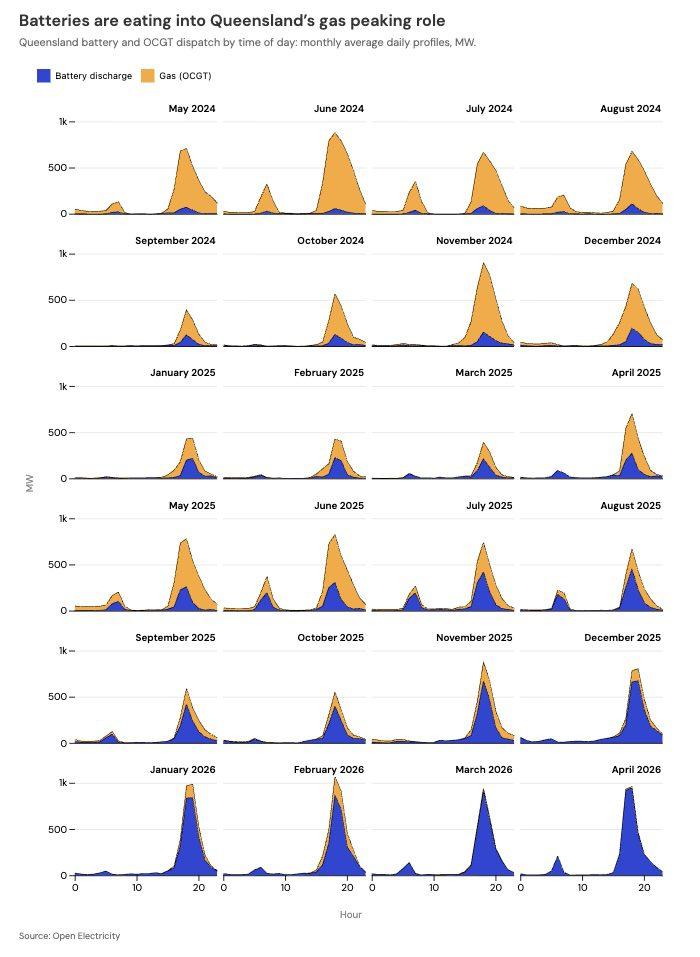
Graph of the day: in just 2 years, batteries have replaced gas turbines as the firming generators for the morning/evening peaks in Queensland.
-
Graph of the day: in just 2 years, batteries have replaced gas turbines as the firming generators for the morning/evening peaks in Queensland. Now *that’s* a disruptive technology.
@layoutSubviews That’s bloody impressive! I didn’t think we were capable of such fundamental moves any more as a society!
-
Graph of the day: in just 2 years, batteries have replaced gas turbines as the firming generators for the morning/evening peaks in Queensland. Now *that’s* a disruptive technology.
@layoutSubviews nice! Some national improvements!
On the negative perspective:
Does the peek seem more steep. Does that mean that homebatteries are not a thing or are there other reasons? -
Graph of the day: in just 2 years, batteries have replaced gas turbines as the firming generators for the morning/evening peaks in Queensland. Now *that’s* a disruptive technology.
@layoutSubviews
Whoa! That is one *rapid* transition at grid level 🤩 -
Graph of the day: in just 2 years, batteries have replaced gas turbines as the firming generators for the morning/evening peaks in Queensland. Now *that’s* a disruptive technology.
@layoutSubviews how did you manage to push against the f*cking hard-core oil and gas industry. They have such a stranglehold here in Germany…
-
Graph of the day: in just 2 years, batteries have replaced gas turbines as the firming generators for the morning/evening peaks in Queensland. Now *that’s* a disruptive technology.
@layoutSubviews Very interesting! This battery capacity will probably also help to reduce the needed gas turbine capacity for filling the "seasonal lulls in wind and solar generation". Why? Because the batteries can flatten the daily load profile for the gas turbines. This way you can reduce the gas turbine capacity from peak loads to the daily averages.
-
Graph of the day: in just 2 years, batteries have replaced gas turbines as the firming generators for the morning/evening peaks in Queensland. Now *that’s* a disruptive technology.
@layoutSubviews kinda want to see another winter's worth of data.
-
Graph of the day: in just 2 years, batteries have replaced gas turbines as the firming generators for the morning/evening peaks in Queensland. Now *that’s* a disruptive technology.
@layoutSubviews
for each month is the x axis time, as in days of the month?
Wondering why peak requirement is so much higher in Jan 2026 than Jan 2025 and why it all seems to be back ended in the month.Or am I reading it incorrectly.
Either way looks impressive that batteries are displacing gas.
-
@layoutSubviews
for each month is the x axis time, as in days of the month?
Wondering why peak requirement is so much higher in Jan 2026 than Jan 2025 and why it all seems to be back ended in the month.Or am I reading it incorrectly.
Either way looks impressive that batteries are displacing gas.
@winkleink @layoutSubviews
For each month the x-axis is time-of day (the scale runs from 0 to 24, and below in light grey the unit 'hour' is visible).But you are right, the difference in peak power between Jan 2025 and 2026 is striking. That would a lot of new airco's!
-
Graph of the day: in just 2 years, batteries have replaced gas turbines as the firming generators for the morning/evening peaks in Queensland. Now *that’s* a disruptive technology.
Werte @Bundesregierung und @BMWK, könnten wir diese Disruption bitte auch in unserem Land angehen? Als Bonus kämen wir nebenbei auch den Klimaschutzzielen näher und verringerten unsere Abhängigkeit von Rohstoffen.
-
Graph of the day: in just 2 years, batteries have replaced gas turbines as the firming generators for the morning/evening peaks in Queensland. Now *that’s* a disruptive technology.
@layoutSubviews @MichaelChrist Gibt es da nicht ehrlicherweise einen gewissen Unterschied in den Breitengraden die es in Australien auch in deren Winter einfacher macht die Batterien zu befüllen?
-
@layoutSubviews @MichaelChrist Gibt es da nicht ehrlicherweise einen gewissen Unterschied in den Breitengraden die es in Australien auch in deren Winter einfacher macht die Batterien zu befüllen?
@langhaarschneider @layoutSubviews Ja. Die haben deutlich höhere solare Einstrahlung. Photovoltaik lohnt sich dort so richtig. Allerdings führt das auch zu höheren Strompreisschwankungen morgens und abends. Also rentieren sich Großbatteriespeicher noch schneller.
-
@layoutSubviews nice! Some national improvements!
On the negative perspective:
Does the peek seem more steep. Does that mean that homebatteries are not a thing or are there other reasons?@twosky2000
My guess is because batteries can "spin up" faster? They can deliver power the instant it's needed instead of slowly building up speed so they're operational by the time the power is actually needed.
@layoutSubviews -
@twosky2000
My guess is because batteries can "spin up" faster? They can deliver power the instant it's needed instead of slowly building up speed so they're operational by the time the power is actually needed.
@layoutSubviews@justme @layoutSubviews that's something I missed, generated not requested power.
It's just a fear I have here in Switzerland, instead of the population becoming more self sufficient with solar grants, big buisness get's the grants until it becomes unreasonable to install solar/batteries.
It's still better for the climate, but the people do not get more independence. -
M monkee@other.li shared this topic