Shifting baseline syndrome ( #SBS ) is what happens when we forget how vibrant the natural world used to be.
-
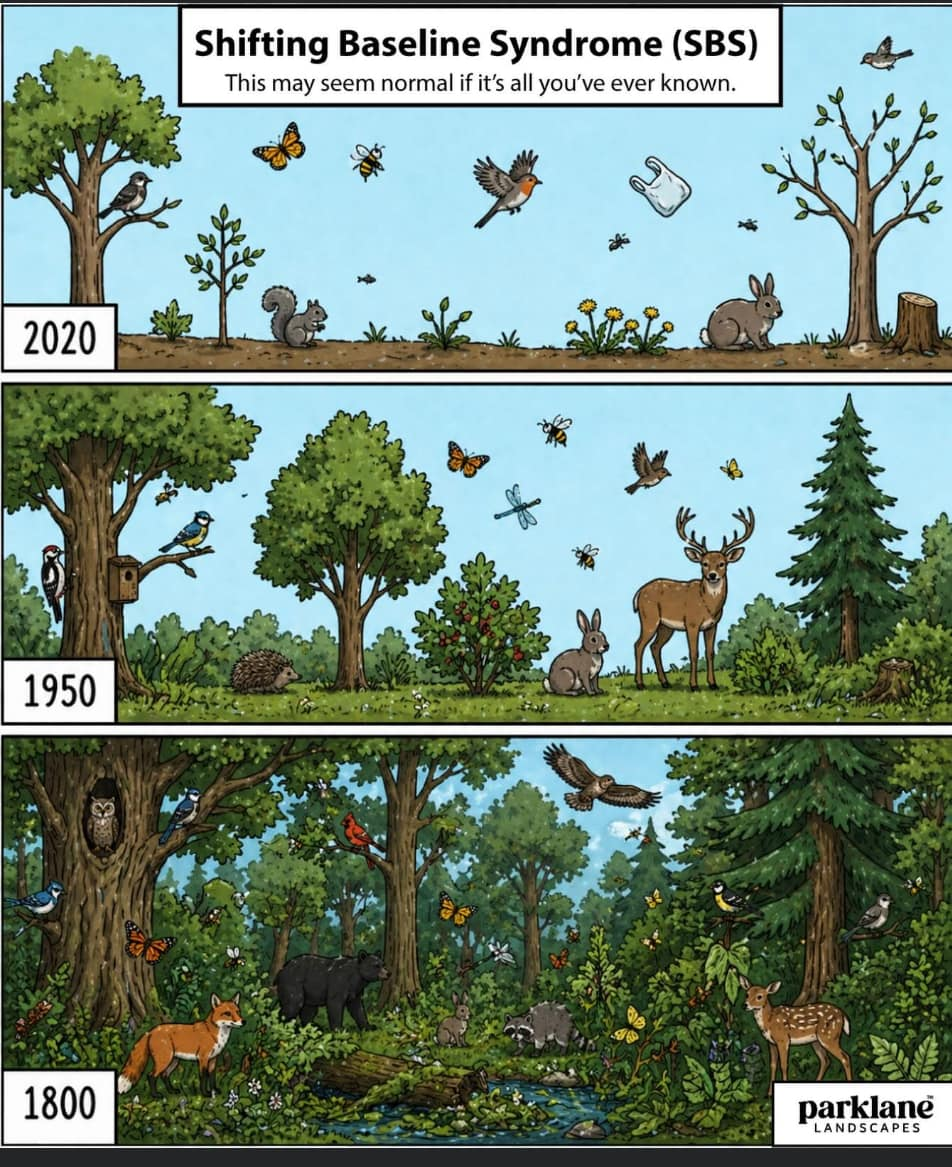
Shifting baseline syndrome ( #SBS ) is what happens when we forget how vibrant the natural world used to be. Each generation grows up with a more depleted environment and calls it “normal,” simply because it’s all they’ve ever known.
Researchers warn that this shift lowers our expectations, increases our tolerance for decline, and reduces our urgency to protect what’s left.
-
Shifting baseline syndrome ( #SBS ) is what happens when we forget how vibrant the natural world used to be. Each generation grows up with a more depleted environment and calls it “normal,” simply because it’s all they’ve ever known.
Researchers warn that this shift lowers our expectations, increases our tolerance for decline, and reduces our urgency to protect what’s left.
@Jeroen89 The same is valid for our night sky. With all the light pollution we forget how a starry sky could look like

https://nationalgeographic.de/umwelt/2025/09/verschwinden-die-sterne-vom-nachthimmel/
by @skyglowberlin -
Shifting baseline syndrome ( #SBS ) is what happens when we forget how vibrant the natural world used to be. Each generation grows up with a more depleted environment and calls it “normal,” simply because it’s all they’ve ever known.
Researchers warn that this shift lowers our expectations, increases our tolerance for decline, and reduces our urgency to protect what’s left.
I was taught that Mesopotamia was "The Fertile Crescent", and that it is in what today is Iraq and Turkey.
I remember watching the news in 1991 the first time we bombed the shit out of Iraq. It didn't look very fertile to me. It looked like a desert.
Same thing?
-
I was taught that Mesopotamia was "The Fertile Crescent", and that it is in what today is Iraq and Turkey.
I remember watching the news in 1991 the first time we bombed the shit out of Iraq. It didn't look very fertile to me. It looked like a desert.
Same thing?
-
Shifting baseline syndrome ( #SBS ) is what happens when we forget how vibrant the natural world used to be. Each generation grows up with a more depleted environment and calls it “normal,” simply because it’s all they’ve ever known.
Researchers warn that this shift lowers our expectations, increases our tolerance for decline, and reduces our urgency to protect what’s left.
-
M monkee@other.li shared this topic